
Droven io AI Automation Tools: Practical Guide for Businesses in the USA
Droven io AI automation tools is a search term many people use when they are trying to understand how Droven.io relates to AI, workflow automation, business tools, and practical automation systems. The important point is this: Droven.io is best treated as an informational AI and technology resource, not as a direct replacement for workflow automation platforms such as Zapier, Make, n8n, Microsoft Power Automate, or custom AI agent systems.
This guide explains what people usually mean when they search for “droven io ai automation tools”, how to evaluate droven io ai automation in USA from a business perspective, and how to choose the right automation stack for real workflows such as sales follow-up, email management, CRM updates, reporting, document processing, and customer support.
If you are new to this topic, start with our AI automation for small business guide. If you want practical workflow examples after this article, explore the TakeYourAI workflow templates library.
Quick answer: Droven.io can help users learn about AI tools, automation, and digital transformation topics, but businesses should still choose a dedicated automation platform for execution. For most USA businesses, the right AI automation stack combines a workflow builder, existing business apps, an AI model, clear human review gates, privacy controls, and measurable workflow outcomes.
What “Droven io AI Automation Tools” Means
The keyword droven io ai automation tools is not just a normal product search. It is usually a research-style query. The searcher may have seen Droven.io while reading about artificial intelligence, automation, emerging technology, digital transformation, or business productivity, then searched for a more practical explanation of which AI automation tools actually matter.
Droven.io publishes content around artificial intelligence, AI tools, automation, digital transformation, software development, and the future of work. For that reason, people may connect the brand name “Droven.io” with the broader topic of AI automation, even when they are actually looking for practical platforms, workflow examples, or business implementation guidance.
A better way to understand the search intent is:
| Search phrase | Likely intent | Best article angle |
|---|---|---|
| droven io ai automation tools | The user wants to know what AI automation tools are connected to Droven.io content or recommendations. | Explain Droven.io as a learning source and compare practical automation tool categories. |
| droven io ai automation in usa | The user wants USA-focused business automation guidance. | Show how USA businesses can evaluate workflow automation tools safely. |
| Droven.io AI tools | The user may want a list of AI tools or categories. | Explain tool types: workflow builders, AI agents, CRM automation, email automation, reporting, and document processing. |
| AI automation tools for business | The user is comparing platforms to automate business processes. | Provide practical selection criteria and use cases. |
Is Droven.io an AI Automation Tool?
Based on its public pages, Droven.io is better understood as a content and information website covering AI, technology, software, automation, and digital transformation. You can visit the Droven.io homepage, its artificial intelligence category, and its AI tools page to see the informational nature of the site.
That distinction matters because a business needs different things from a reading resource and an execution platform.
| Need | Droven.io-style resource | Automation platform |
|---|---|---|
| Learn about AI tools | Useful for research and explanation. | May provide documentation and templates. |
| Connect apps | Not the main purpose. | Core function of tools such as Zapier, Make, n8n, and Power Automate. |
| Run workflows | Not the main purpose. | Triggers, actions, schedules, APIs, and workflow logic. |
| Add AI steps | Can explain concepts and tools. | Can connect AI models to real business data and actions. |
| Track errors and approvals | Usually not applicable. | Needed for production workflows. |
In short, Droven.io can help with understanding the landscape. The actual automation work should happen in tools built to connect apps, process data, run workflows, and manage approvals.
Why USA Businesses Search for AI Automation Tools
USA businesses are often looking for AI automation because teams are overloaded with repeated work across email, CRM, spreadsheets, project tools, support systems, documents, and reporting. A small business may not need a full custom software system at first. It may need a reliable automation layer that connects the tools it already uses.
Common reasons businesses search for droven io ai automation in USA include:
- Reducing manual admin work.
- Following up with leads faster.
- Summarizing customer emails and support tickets.
- Updating CRM records without copy-paste.
- Creating weekly reports automatically.
- Processing invoices, PDFs, and forms.
- Routing approvals to the right person.
- Using AI safely without letting it make risky decisions alone.
The best approach is not to ask, “Which AI tool is the best?” The better question is, “Which workflow should we automate first, and what controls do we need before AI can touch it?”
Main Categories of AI Automation Tools
AI automation tools are not all the same. Some connect apps. Some build visual workflows. Some provide AI agents. Some automate Microsoft environments. Some are better for technical teams, while others are easier for non-technical teams.
| Tool category | What it does | Example tools |
|---|---|---|
| No-code workflow automation | Connects triggers and actions between business apps. | Zapier, Make, Microsoft Power Automate. |
| Technical workflow automation | Builds more flexible workflows with APIs, conditions, custom logic, and self-hosting options. | n8n, Pipedream, custom code workflows. |
| AI model layer | Classifies, summarizes, drafts, extracts, and reasons over business data. | OpenAI, Gemini, Claude, or other model providers. |
| CRM automation | Updates leads, deals, notes, tasks, owners, and follow-up status. | HubSpot, Salesforce, Pipedrive, Airtable. |
| Email and support automation | Classifies messages, drafts replies, creates tickets, and escalates urgent issues. | Gmail, Outlook, Zendesk, Intercom, Help Scout. |
| Document automation | Extracts fields from PDFs, invoices, forms, receipts, and contracts. | Document AI tools, OCR tools, AI vision models, parsers. |
| Reporting automation | Collects metrics, summarizes performance, and sends recurring reports. | Google Sheets, Airtable, Looker Studio, workflow builders, AI summary steps. |
Zapier describes itself as a platform for connecting apps and automating workflows, with many integrations and AI-related capabilities: What is Zapier?. Make describes itself as an automation platform for connecting applications and automating workflows: What is Make?. Microsoft Power Automate is positioned around process automation, including AI-powered, digital, and robotic process automation: Microsoft Power Automate.
How to Choose AI Automation Tools for Your Business
Do not choose AI automation tools from a random list. Choose them based on the workflow you want to improve. A business that wants to automate lead follow-up needs different tools than a business that wants invoice processing, customer support triage, or weekly reporting.
The safest selection process starts with the workflow, not the software.
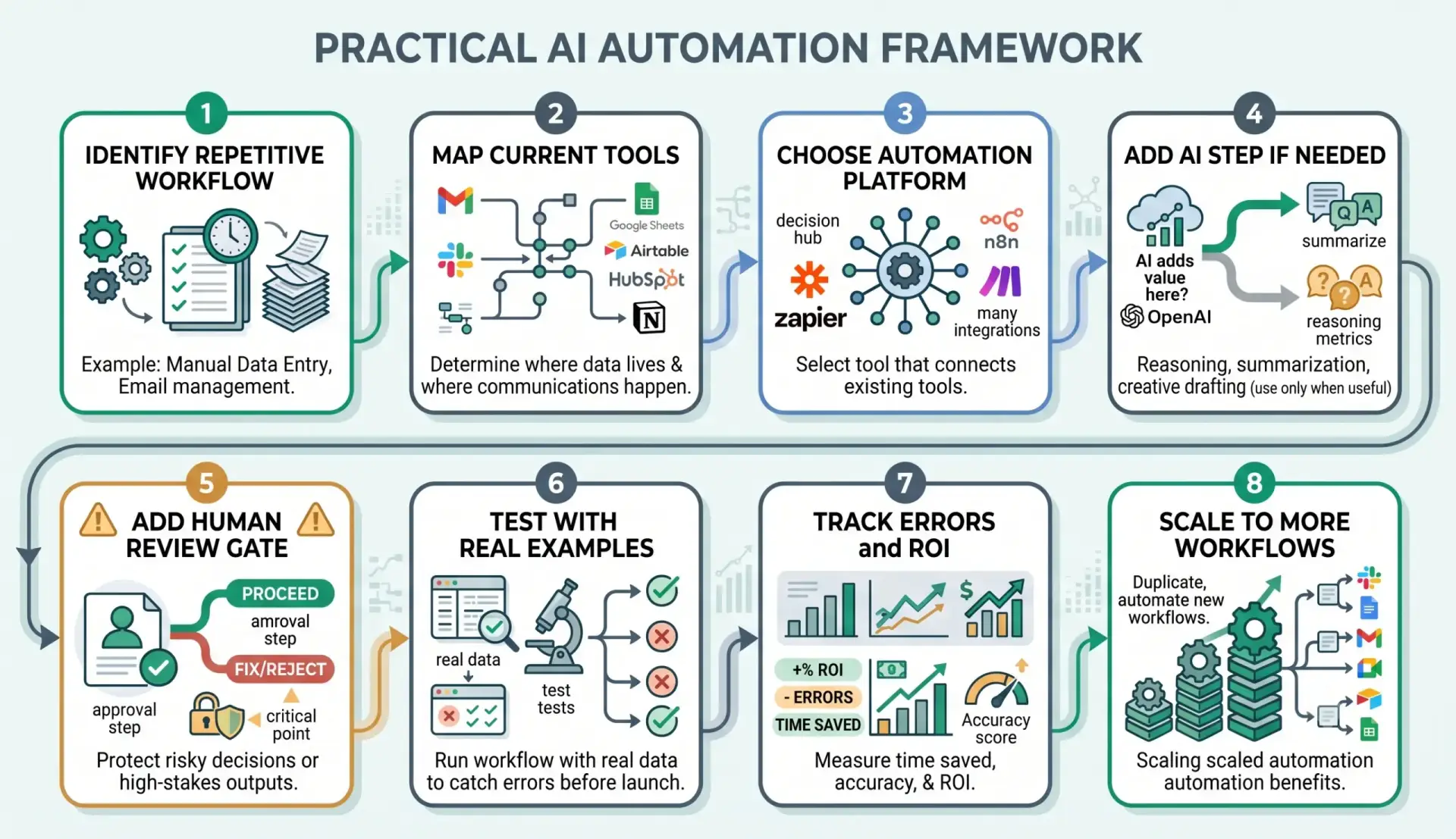
| Selection step | Question to ask | Why it matters |
|---|---|---|
| Identify repetitive workflow | Which task happens repeatedly every week? | Automation works best on repeated, predictable workflows. |
| Map current tools | Where does the data start and where should it go? | Integrations matter more than hype. |
| Choose automation platform | Do you need simple no-code automation, visual logic, or technical flexibility? | The wrong platform creates maintenance problems. |
| Add AI only where useful | Does the workflow need classification, summarization, extraction, or drafting? | Not every automation needs AI. |
| Add human review | What actions should never happen without approval? | Protects money, customers, privacy, and brand trust. |
| Test with real examples | Can the workflow handle normal, messy, missing, and edge-case inputs? | Prevents demo workflows from breaking in real operations. |
| Track ROI and errors | How much time is saved, and where does the workflow fail? | Improves automation over time. |
n8n also offers AI-related workflow building features, including a natural language AI workflow builder in n8n Cloud: n8n AI workflow builder documentation. This can be useful for teams that want more flexible workflow design but still need careful testing and ownership.
Best Workflows to Automate First
If you are researching droven io ai automation tools, the best starting point is usually not a huge company-wide AI project. Start with one workflow that is frequent, painful, measurable, and safe to test.
| Workflow | What AI can do | Human review needed when |
|---|---|---|
| Lead qualification | Classify leads, score fit, summarize intent, and route follow-up. | High-value lead, unclear context, pricing, or custom offer. |
| Sales follow-up | Draft follow-up emails and create reminders. | External message, pricing, contract, or sensitive account. |
| Email management | Classify messages, detect urgency, summarize threads, and draft replies. | Angry customer, legal issue, refund, VIP client, or unclear sender. |
| CRM updates | Extract data from forms, calls, emails, and notes. | Important fields, deal stages, owner changes, or duplicate records. |
| Invoice processing | Extract invoice fields, check vendor, detect duplicates, and route approval. | Payment approval, high amount, changed vendor details, or duplicate risk. |
| Customer support triage | Classify tickets, summarize issues, draft responses, and assign priority. | Complaint, refund, sensitive account, or high-impact issue. |
| Weekly reporting | Summarize metrics, highlight changes, and draft reports. | Performance interpretation or business decision-making. |
For practical examples, read our templates for AI lead qualification, sales follow-up automation, email management automation, invoice processing automation, and weekly AI reporting automation.
AI Automation Tool Comparison Framework
The best tool depends on your team’s skill level, current stack, budget, privacy requirements, and workflow complexity. Here is a practical comparison framework for USA businesses evaluating AI automation tools.
| Criterion | What to look for | Why it matters |
|---|---|---|
| Integrations | CRM, email, calendar, spreadsheets, support tools, forms, storage, and project tools. | Automation fails if it cannot connect to your real work. |
| AI model support | Ability to connect OpenAI, Gemini, Claude, or built-in AI features. | Needed for classification, summarization, extraction, and drafting. |
| Workflow logic | Filters, branches, conditions, retries, webhooks, schedules, and error handling. | Real workflows are rarely one-step automations. |
| Human approval | Approval steps, review queues, draft-only mode, and manual checkpoints. | Protects sensitive business actions. |
| Data privacy | Control over what data enters AI models and third-party tools. | Important for customer, employee, financial, and business data. |
| Audit logs | Records of inputs, outputs, approvals, errors, and final actions. | Makes workflows easier to debug and review. |
| Pricing | Tasks, operations, runs, AI usage, team seats, and premium app limits. | Costs can grow with workflow volume. |
| Scalability | Ability to handle more workflows, more users, more data, and more exceptions. | Prevents rebuilding everything later. |
Human Review and Risk Controls
The most important rule in business AI automation is simple: AI can prepare work, but humans should review risky actions. This is especially true for USA businesses that handle customer communications, contracts, payment information, employee data, healthcare-adjacent content, financial records, or legal-sensitive messages.
Human review should be required before:
- Sending external emails to customers, leads, vendors, or partners.
- Approving invoices, payments, refunds, discounts, or contract terms.
- Changing CRM deal stages, customer status, or important account fields.
- Publishing social media posts with claims, offers, or sensitive topics.
- Replying to public reviews or angry customers.
- Deleting records, files, or customer data.
- Using AI outputs in business decisions without enough context.
Practical rule: use AI to classify, summarize, draft, extract, and recommend. Keep humans responsible for approval, judgment, customer trust, payments, contracts, and public-facing decisions.
AI Automation Tool Review Checklist
Before a business chooses an automation stack, it should review the tool against workflow fit, integrations, AI usefulness, human oversight, privacy, reliability, pricing, and long-term maintenance.
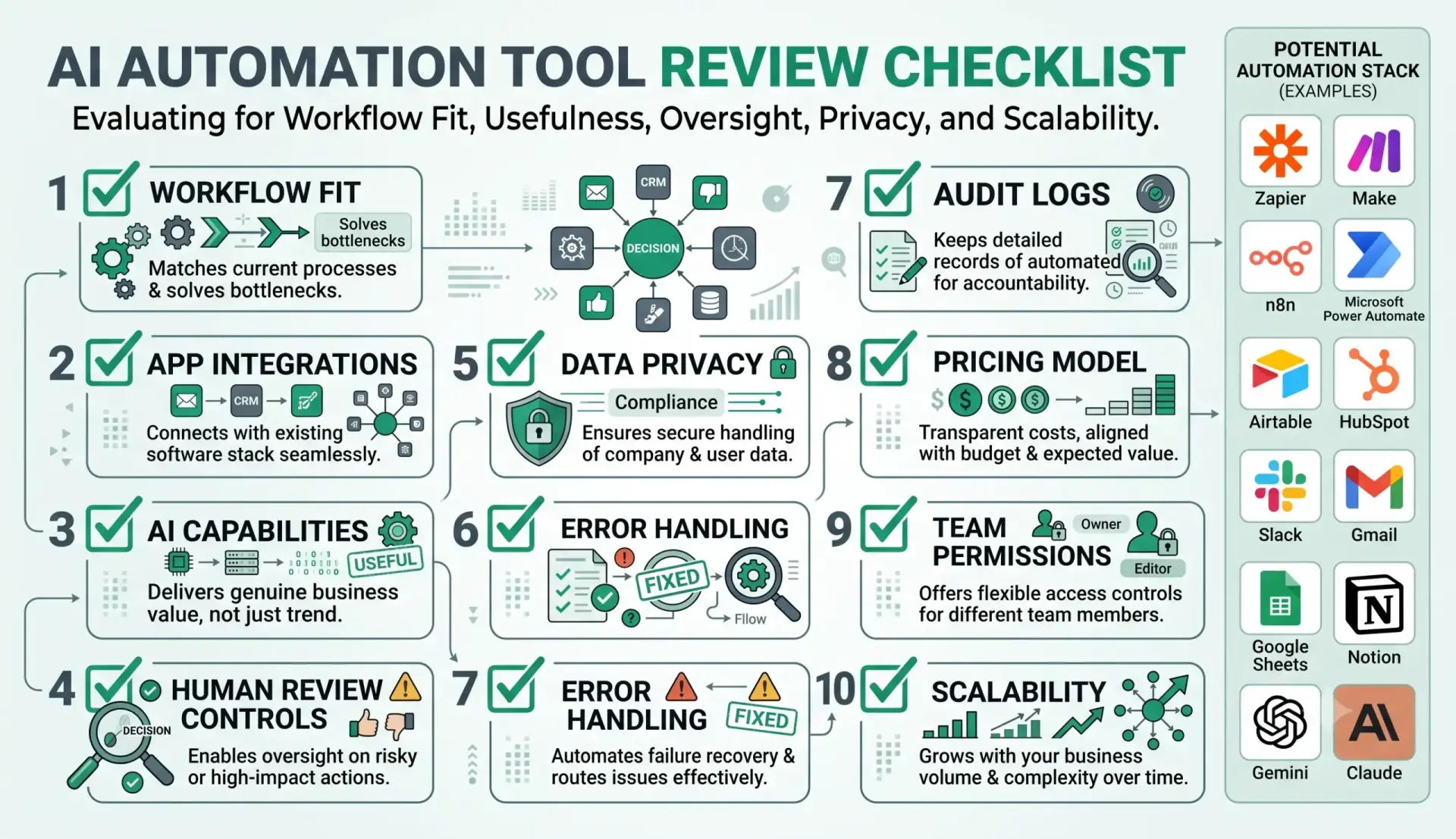
| Checklist item | Question | Pass condition |
|---|---|---|
| Workflow fit | Does the tool solve the exact workflow we want to automate? | The tool supports the trigger, actions, and review steps needed. |
| App integrations | Does it connect to our CRM, email, forms, spreadsheets, and task tools? | Required integrations are available without fragile workarounds. |
| AI capabilities | Can it classify, summarize, extract, draft, or route with AI? | AI output can be structured, reviewed, and logged. |
| Human review controls | Can humans approve before external or high-impact actions? | Approval gates are easy to add and enforce. |
| Data privacy | Do we control what customer or business data enters AI steps? | Sensitive data can be limited, masked, or kept out of AI where needed. |
| Error handling | What happens when a tool call fails? | The workflow logs errors and alerts a human. |
| Audit logs | Can we see what ran, what changed, and who approved it? | Inputs, outputs, approvals, and actions are traceable. |
| Pricing model | Does pricing grow by tasks, runs, seats, AI tokens, or premium apps? | Costs are predictable at realistic workflow volume. |
| Team permissions | Can users have different access levels? | Non-technical users can review without controlling everything. |
| Scalability | Can the workflow grow without becoming impossible to maintain? | The system supports more workflows, branches, and monitoring. |
Simple Implementation Plan
A business researching droven io ai automation in USA should not start with a complex AI agent. Start with one practical workflow and build from there.
- Choose one workflow. Pick a repeated workflow such as lead follow-up, email triage, invoice processing, CRM updates, or reporting.
- Map the current process. Write down where the information starts, who handles it, where it goes, and what decisions are made.
- Select the automation platform. Use Zapier or Make for simpler no-code workflows, n8n for more flexible technical workflows, or Power Automate for Microsoft-heavy environments.
- Add AI only where needed. Use AI for classification, summarization, drafting, extraction, or routing—not for every step.
- Create human review gates. Require approval before external messages, payments, record changes, publishing, and sensitive decisions.
- Test with real examples. Use normal inputs, messy inputs, missing data, duplicates, angry messages, and high-risk cases.
- Log every run. Store workflow status, owner, AI output, review result, error, and final action.
- Measure results. Track time saved, errors avoided, response time, manual reviews, and cost per workflow.
- Improve before scaling. Fix edge cases before adding more workflows.
- Document the workflow. Keep a clear record of triggers, actions, approval rules, and failure paths.
Common Mistakes
Many teams fail with AI automation because they chase tools before defining the workflow. The tool matters, but the workflow design matters more.
| Mistake | Why it hurts | Better approach |
|---|---|---|
| Choosing a tool before choosing a workflow | The team buys software without a clear use case. | Start with one repeated workflow and measurable goal. |
| Adding AI to every step | Costs increase and the workflow becomes harder to debug. | Use AI only for language, classification, extraction, or reasoning tasks. |
| No human review | AI may send wrong messages, approve risky actions, or update records incorrectly. | Add approval gates before sensitive actions. |
| No error handling | Failed automations disappear silently. | Log failures and notify a human. |
| No source of truth | The workflow uses outdated or conflicting data. | Define where CRM, customer, invoice, or task data should live. |
| No cost monitoring | Task runs and AI usage can grow unexpectedly. | Track operations, runs, AI calls, and review volume. |
| Scaling too early | One weak workflow becomes ten weak workflows. | Stabilize the first workflow before expanding. |
Final Recommendation
Treat droven io ai automation tools as a research keyword, not a finished software choice. Droven.io can help users explore AI and automation topics, but a real business workflow still needs a dedicated automation platform, clear tool integrations, AI steps, human review, error handling, and measurable outcomes.
For most USA small businesses, the best first automation is not a fully autonomous AI agent. It is a controlled workflow that saves time while keeping humans responsible for important decisions. Start with one workflow, connect the tools you already use, add AI where it adds clear value, and keep approval gates for customer-facing, financial, legal, public, or high-impact actions.
After this article, the best next step is to choose a workflow template from the TakeYourAI workflow templates library, such as email management automation, sales follow-up automation, CRM update automation, or weekly AI reporting automation.
FAQ
What does “droven io ai automation tools” mean?
It usually refers to people searching for information about Droven.io and AI automation tools. The best interpretation is that the user wants practical guidance on AI automation platforms, workflow tools, and business automation use cases.
Is Droven.io itself an AI automation platform?
Droven.io is best treated as an informational AI and technology website. Businesses that want to run automations should still evaluate execution platforms such as Zapier, Make, n8n, Microsoft Power Automate, or custom workflow systems.
What is the best AI automation tool for USA businesses?
There is no single best tool for every business. Zapier and Make are often useful for no-code workflows, n8n is useful for more flexible technical workflows, and Microsoft Power Automate fits many Microsoft-heavy teams. The right choice depends on integrations, workflow complexity, approval needs, privacy, and budget.
What workflows should a business automate first?
Start with repeated workflows such as lead follow-up, email triage, CRM updates, invoice processing, customer support triage, meeting notes, document processing, or weekly reporting. Choose a workflow that is frequent, measurable, and safe to test.
Should AI automations run without human review?
Not for important actions. AI can classify, summarize, draft, extract, and recommend, but humans should review external messages, payments, contracts, customer complaints, public posts, sensitive records, and high-impact business decisions.
How should I evaluate AI automation tools?
Evaluate workflow fit, app integrations, AI capabilities, human review controls, data privacy, error handling, audit logs, pricing model, team permissions, and scalability before choosing a tool.